Nanoscaffolding and IPTV: How Tissue-Engineering Labs Stream Live Sports in the USA
It is 2:47 a.m. and your electrospinning rig is still humming. The nanofiber scaffold you seeded six hours ago will not be ready for imaging until morning, and the incubator alarm will not ping for another three hours. That dead time — the long, quiet gaps between seeding, spinning, sterilizing and staining — is the hidden cost of nanoscaffolding research. Most labs fill it with scrolling, bad coffee and a frozen cable feed on the corner monitor. A growing number of them are filling it with live sports in 4K instead. That is the bridge between nanotechnology and IPTV: the same discipline that makes you wait patiently for a scaffold to mature is the discipline that makes a reliable, buffer-free sports stream so valuable. In a nanoscaffolding lab, downtime is not empty — it is the only television time you get.
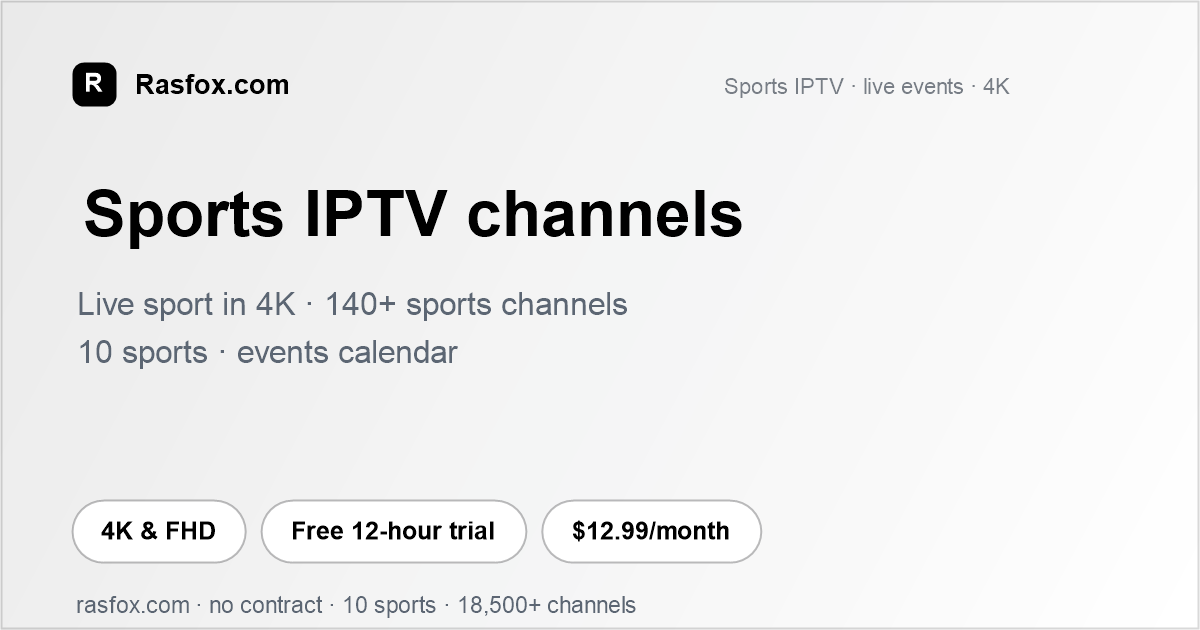
This article looks at IPTV through a very specific lens: the scientist, engineer and biomaterials professional who spends twelve-hour days in a cleanroom or cell-culture suite and refuses to miss the match, the fight or the Grand Prix. We will cover what IPTV actually is, how it fits into a research environment, what the US sports landscape looks like through a RasFox subscription, what hardware you need, and how to stay on the right side of the law while doing it.
What Is IPTV and How Does It Transform Live TV and Live Sports?
IPTV stands for Internet Protocol Television. Instead of pulling a signal down from a satellite dish or squeezing channels through a coaxial cable package, IPTV delivers the broadcast as data packets over your existing internet connection. That single architectural difference changes everything about how, when and where you watch.
Traditional cable is built around scarcity: a fixed number of channels, a fixed set-top box, a fixed living room, and a two-year contract that punishes you for leaving. IPTV is built around flexibility. The stream is just data, so it can be decoded on a smart TV, a Fire Stick, an Android box, a phone, a tablet, or a lab workstation running VLC on a second monitor.
Here is what a modern premium IPTV package typically delivers — and what RasFox specifically advertises:
- 12,000+ live channels spanning sports, news, entertainment and regional broadcasts
- 40,000+ VOD titles — films, series and full match replays on demand
- 4K at 50 FPS on supported sports feeds, which matters enormously for fast-motion content like football, F1 and UFC
- Two simultaneous screens — one in the living room, one in the office or on a phone
- No contract, no installation, no dish — cancel whenever you want
- A 24-hour free trial so you can stress-test the service before paying anything
- Portuguese and Spanish language support, useful for international research groups and postdocs
Why does 50 FPS matter? Because 25 or 30 frames per second turns a fast-moving ball into a smear. If you have ever tried to follow a Champions League counterattack on a low-bitrate stream, you already understand the difference between "watching" and "actually seeing the play."
Why Nanoscaffolding Researchers Are Switching to IPTV
Nanoscaffolding work is defined by long, structured waiting. Electrospinning runs take hours. Cell seeding needs to sit undisturbed. Degradation studies in simulated body fluid can run for weeks. Confocal imaging slots are booked at odd hours because the microscope is shared across three departments. None of that time is truly free, but a large portion of it is screen-adjacent time — you are in the room, monitoring a readout, doing data entry, or waiting on a centrifuge.
That is exactly the environment where IPTV outperforms every traditional option:
- Multi-screen reality. A lab PC with a second monitor can run your analysis software on one display and a live match on the other. Two simultaneous streams on one subscription makes this practical without buying a second plan.
- No installation constraints. University buildings rarely allow satellite dishes, and campus cable is often limited to a handful of public channels. IPTV only needs the network you already have.
- Portability between sites. Core facilities, partner labs, conference hotels, home offices — the same subscription follows you across all of them.
- On-demand catch-up. If a critical timepoint lands exactly when your team is playing, the VOD library means you watch it later in full quality instead of hunting for a grainy clip.
- Background-friendly audio. Sports commentary is the ideal low-attention soundtrack for pipetting, aliquoting and formatting figures.
If you are setting up a shared lab screen or a break room display, choosing a best IPTV service that is stable under continuous playback is far more important than chasing the cheapest channel list you can find on a forum. Buffer-heavy streams are worse than no stream at all when eight people are staring at a frozen frame during a penalty shootout.
For research groups with international members, a service with proper Portuguese and Spanish support also removes a real friction point. A Brazilian postdoc and a Venezuelan visiting scholar should not have to fight over which regional feed the lab gets to watch on a Friday afternoon.
IPTV in the United States: The Sports Landscape English-Speaking Fans Actually Care About
The United States is one of the most fragmented sports markets on earth. Rights are split across broadcasters, regional sports networks, streaming exclusives and pay-per-view, which means a traditional cable bundle can easily cost more than a car payment and still leave you without the one game you wanted to see.
That fragmentation is precisely why IPTV has grown so quickly among American viewers. A single subscription can consolidate the pieces that cable splits apart.
The channels that matter in the US market
- ESPN, ESPN2, ESPNU, ESPN Deportes — the backbone of American sports coverage
- Fox Sports 1 and FS2 — college football, MLB, NASCAR, World Cup cycles
- CBS Sports, NBC Sports, ABC — NFL Sundays, March Madness, Sunday Night Football
- TNT and TBS — NBA and MLB postseason coverage
- NFL Network, NBA TV, MLB Network, NHL Network — league-dedicated 24/7 feeds
- Big Ten Network and regional sports networks — for alumni who moved across the country
- beIN Sports, DAZN, Sky Sports, Eurosport — the international layer that American cable almost never includes
The competitions that fill the calendar
Between the NFL season, the NBA and NHL schedules, MLB from April to October, MLS and Liga MX, NCAA football and March Madness, plus the best IPTV for live football window that brings the Premier League, Champions League, La Liga and Serie A to American screens, there is essentially no week of the year without something worth watching. Add Formula 1 on Sunday mornings and UFC pay-per-view cards on Saturday nights, and you have a full annual calendar.
Built sports-first, from a radio tradition
RasFox did not start as a generic streaming reseller. Its lineage runs back to Radio Malena 89.1 FM in Buenos Aires, at Venezuela 370 — a station rooted in tango, Argentine culture and the deeply regional passion for football commentary. That background explains the product philosophy: this is a service engineered around sports channels and live sports events first, with everything else built around that core. The company now serves lusophone and Latino communities worldwide, and it brings that same broadcast sensibility to English-speaking sports fans in the United States.
Practically, that means priority on the feeds people actually gamble their evening on: the 4K 50 FPS sports streams, the reliable regional sports networks, and the international channels that carry the competitions American cable keeps locking behind extra paywalls.
Hardware and Setup Guide: From the Lab Bench to the Living Room
One of the underrated advantages of IPTV is that it is hardware-agnostic. You almost certainly already own a capable device.
Recommended devices
- Amazon Fire TV Stick 4K or 4K Max — the cheapest, fastest route to a working setup
- Android TV boxes — the most flexible option, and the easiest to configure with a custom player
- Apple TV 4K — excellent for households already inside the Apple ecosystem
- Smart TVs — Samsung Tizen and LG webOS both support IPTV players directly
- PC or Mac — VLC, MyIPTV or similar players turn a lab workstation into a second screen at no cost
- MAG boxes — still the standard in many dedicated setups, popular with people who want a set-top-box feel
Network requirements
For a comfortable 4K stream, plan on 25 Mbps of stable bandwidth per screen. For HD, 10–15 Mbps is enough. Stability matters more than raw speed: a 200 Mbps connection with heavy packet loss will stutter, while a clean 30 Mbps line will play flawlessly.
A few practical tips that make a measurable difference:
- Use Ethernet where you can. Wired beats Wi-Fi every single time for live sports.
- Prefer 5 GHz or Wi-Fi 6 if cabling is impossible, and keep the device away from crowded 2.4 GHz bands.
- Do not run the stream while a full-disk backup is uploading. Saturating your uplink is the most common cause of "IPTV is buffering" complaints.
- Try the 24-hour free trial first and test it during peak hours, not at 6 a.m.
If you want a no-contract route to test in your own environment, the 24-hour free IPTV trial is the sensible way to benchmark stability before committing to anything.
Legal vs. Illegal IPTV: Safety and Best Practices
This is the part most IPTV articles skip, and it matters. IPTV itself is completely legal technology — it is the same delivery method used by major telecom operators worldwide. What varies is whether the content being streamed is licensed.
The grey and black market is full of "free IPTV lists" and one-dollar monthly subscriptions. The risks are concrete and well documented:
- Malware and credential theft — pirated streaming apps are a common delivery vector for trojans
- Stream hijacking and re-streaming — your connection can be used to relay content to others
- Data collection — free services monetize you, often by selling viewing behaviour
- ISP throttling and notices — some providers actively monitor traffic patterns associated with unlicensed streams
- Zero reliability — servers appear and disappear, usually mid-match
Best practice is straightforward. Choose a service with a clear commercial identity, real customer support, transparent pricing and a legitimate trial process. Avoid anything that requires you to disable your antivirus, install an unsigned APK from a file locker, or pay in untraceable currency to an anonymous seller.
For anyone who wants the convenience of consolidated sports coverage without the risk profile of a grey-market list, a professionally operated option like RasFox IPTV is the safer path: stable infrastructure, human support in Portuguese and Spanish, and a trial you can evaluate honestly. If you also want privacy from your ISP's traffic shaping on a shared or campus network, a reputable commercial VPN is a reasonable complement — but never a substitute for choosing a legitimate provider in the first place.
Bringing It Together: A Lab-Ready Sports Setup
Here is what a practical nanoscaffolding-lab setup looks like in 2025:
- One premium IPTV subscription with two simultaneous screens
- One Fire Stick or Android box on the break room TV
- One desktop player on the workstation with the dual-monitor setup
- Wired connection for the primary display, Wi-Fi 6 for the secondary
- The VOD library as the backup plan when a timepoint inevitably collides with kickoff
That combination costs a fraction of a traditional cable bundle, requires no installation, involves no contract, and does not depend on whether your building management allows a dish on the roof.
Conclusion: Downtime Is Real Time — Use It Well
Nanoscaffolding is a field built on patience: hours of spinning, days of incubation, weeks of degradation testing. You cannot compress that timeline, but you can decide what fills it. A frozen cable feed and a phone screen are not the same experience as a crisp 4K 50 FPS broadcast on the monitor beside your workstation.
RasFox approaches IPTV the way a sports broadcaster would — sports channels and live events first, from a tradition that started at Radio Malena 89.1 FM in Buenos Aires and now reaches lusophone and Latino viewers worldwide, plus English-speaking fans across the United States. With 12,000+ channels, 40,000+ VOD titles, two screens, no contract and a 24-hour free trial, the barrier to testing it is essentially zero.
Start the trial. Run it during a real match, on your real network, in your real lab. Then decide.
FAQ: IPTV for Scientists and Sports Fans in the USA
Is IPTV legal in the United States?
IPTV technology is fully legal in the US. What determines legality is whether the provider holds distribution rights for the content it streams. Licensed, commercially operated IPTV services are lawful; unlicensed free lists and grey-market subscriptions are not, and they carry real security risks.
What internet speed do I need for 4K live sports via IPTV?
Plan on approximately 25 Mbps of stable bandwidth per 4K stream and 10–15 Mbps for HD. Consistency and low packet loss matter more than headline speed, which is why a wired Ethernet connection is strongly recommended for the primary screen.
Can I watch IPTV on two devices at the same time?
Yes — RasFox supports two simultaneous screens on a single subscription. That is usually enough for one break-room TV and one workstation or phone, without purchasing a second plan.
Which sports channels can I expect in the US?
Typical coverage includes ESPN and ESPN2, Fox Sports 1 and FS2, CBS Sports, NBC Sports, TNT and TBS, league networks such as NFL Network, NBA TV and MLB Network, plus international feeds including beIN Sports, DAZN, Sky Sports and Eurosport. Competitions span the NFL, NBA, MLB, NHL, MLS, NCAA, Premier League, Champions League, La Liga, Formula 1 and UFC.
How does the free trial work?
RasFox offers a 24-hour free trial so you can validate stream stability on your own network before paying. Test it during peak viewing hours — that is when the difference between a good provider and a cheap one becomes obvious. No contract is required, and support is available in Portuguese and Spanish.